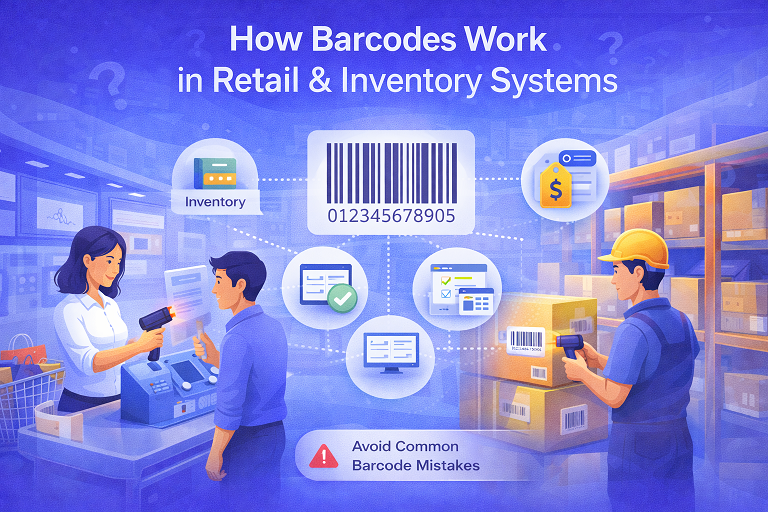
How Barcodes Work in Retail & Inventory Systems
Barcodes play a critical role in modern retail and inventory management. From tracking products in warehouses to scanning items at checkout, barcodes help businesses operate faster, more accurately, and more efficiently.
But how do barcodes actually work behind the scenes? In this guide, we’ll explain how barcodes function within retail and inventory systems and why they are essential for businesses of all sizes.
What Is a Barcode?
A barcode is a machine-readable representation of a product identification number. It allows systems to quickly recognize a product without manual data entry.
Common barcode formats used in retail include UPC and EAN, which encode numeric product information in a pattern of lines and spaces.
How Barcode Scanning Works
When a barcode is scanned, the scanner reads the pattern of bars and spaces and converts it into a numeric code. This number is then sent to the retailer’s system.
The system uses this number to retrieve product details such as:
- Product name
- Price
- Stock quantity
- Product variations
Barcodes at the Point of Sale (POS)
In retail stores, barcodes are scanned at the point of sale. Once scanned, the POS system automatically:
- Identifies the product
- Displays the correct price
- Adds the item to the customer’s bill
- Updates inventory levels in real time
This process reduces pricing errors and speeds up checkout for customers.
How Barcodes Work in Inventory Management
In inventory systems, barcodes help track products throughout their lifecycle — from receiving and storage to sales and restocking.
When items enter a warehouse or store, barcodes are scanned to:
- Log products into inventory
- Assign storage locations
- Track stock movement
- Monitor low inventory levels
Barcodes and Warehousing
Warehouses use barcodes to improve accuracy and efficiency. Staff scan barcodes when picking, packing, and shipping products, ensuring the correct items are sent to customers.
This reduces errors, speeds up order fulfillment, and improves overall supply chain performance.
How Barcodes Connect to Databases
A barcode itself does not store detailed product information. Instead, it acts as a key that links to a database.
When scanned, the system looks up the barcode number and pulls the associated product data from its database. This allows retailers to update product details without changing the barcode.
Why Unique Barcodes Matter
Each product must have a unique barcode. Using duplicate barcodes can cause inventory mismatches, incorrect pricing, and reporting errors.
Unique barcodes ensure accurate tracking across all systems and prevent confusion between different products or variations.
Barcodes in Online Retail
Online marketplaces and eCommerce platforms also rely on barcodes. Barcodes help platforms:
- Identify products
- Manage listings
- Track fulfillment and returns
- Sync inventory across channels
Even when customers never see a physical scanner, barcodes are still working behind the scenes.
Benefits of Using Barcodes in Retail Systems
- Faster checkout and processing
- Reduced human error
- Accurate inventory tracking
- Improved reporting and analytics
- Better customer experience
Common Barcode Issues in Retail Systems
Problems can occur if barcodes are poorly printed, incorrectly sized, duplicated, or not tested. These issues may lead to scanning failures or system errors.
Using high-quality barcode files and testing them before use helps prevent these problems.
Final Thoughts
Barcodes are the backbone of modern retail and inventory systems. They simplify complex processes, improve accuracy, and allow businesses to scale efficiently.
Understanding how barcodes work helps sellers make better decisions and avoid costly mistakes when listing and managing products.
 Buy Barcode in Peshawar
  Buy Barcode in Multan
  Buy Barcode in Sialkot
  Buy Barcode in Lahore
  Buy Barcode in Rahim Yar Khan
  Buy Barcode in Sargodha
  Buy Barcode in Gujranwala
  Buy Barcode in Faisalabad
  Buy Barcode in Quetta
  Buy Barcode in Hyderabad
  Buy Barcode in Bahawalpur
  Pakistan
  Buy Barcode in Sukkur
  Buy Barcode in Rawalpindi
  Buy Barcode in Abbottabad
  Buy Barcode in Larkana