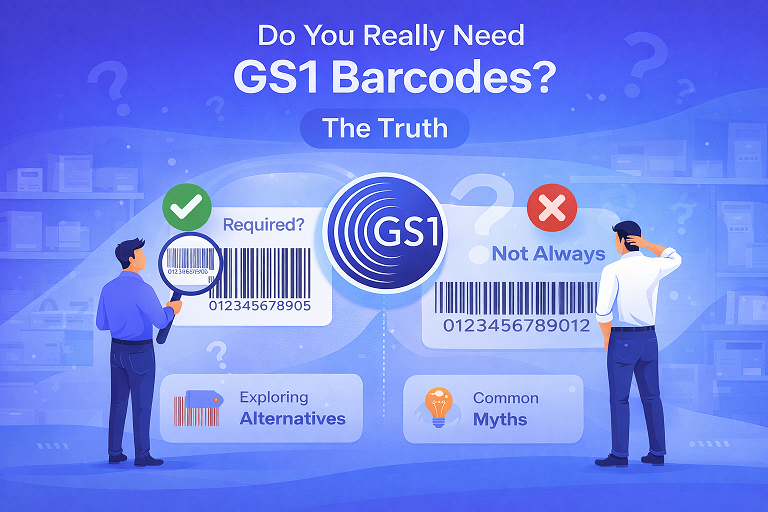
Do You Really Need GS1 Barcodes? The Truth
If you are planning to sell a product, you have probably come across one big question: Do I really need GS1 barcodes?
Many sellers feel confused or pressured into believing that GS1 is the only option. In this article, we’ll explain the truth about GS1 barcodes, when they are required, and when alternative barcode solutions may work just fine.
What Are GS1 Barcodes?
GS1 is a global organization that manages barcode standards. A GS1 barcode is a barcode number issued through GS1, usually tied to a company prefix and registered in the GS1 database.
These barcodes are commonly used by large retailers, global brands, and supply chains that require centralized product data management.
Why Do People Say GS1 Barcodes Are Mandatory?
GS1 barcodes are often recommended because they provide official registration and brand ownership within the GS1 system. Some large retailers prefer or require GS1-issued barcodes to ensure consistency across their databases.
However, this does not mean GS1 barcodes are mandatory for every seller or every platform.
The Reality: Are GS1 Barcodes Always Required?
The honest answer is: no, not always.
Many small businesses, startups, online sellers, and private-label brands successfully use non-GS1 barcodes for years without issues. What matters most is whether the barcode is:
- Unique
- Unused
- Properly formatted
- Scannable by retail systems
When GS1 Barcodes Make Sense
GS1 barcodes may be the right choice if:
- You plan to sell to large national or international retail chains
- You need your company name registered in the GS1 database
- You are managing a large catalog with complex supply chains
- You want centralized product data synchronization
In these cases, GS1 barcodes provide structure and global recognition.
When GS1 Barcodes May NOT Be Necessary
GS1 barcodes may not be required if:
- You sell online through marketplaces or your own website
- You are a small or medium-sized business
- You want a one-time barcode purchase without annual fees
- You only need reliable product identification
Many sellers prefer alternative barcode solutions because they are cost-effective, flexible, and easy to use.
GS1 Barcodes vs Alternative Barcodes
| Feature | GS1 Barcodes | Alternative Barcodes |
|---|---|---|
| Cost | Initial + Annual Fees | One-Time Payment |
| Ownership | Linked to GS1 Company Prefix | Barcode Ownership Included |
| Retail Scanning | Yes | Yes |
| Best For | Large Enterprises | SMEs & Online Sellers |
Will Non-GS1 Barcodes Scan Correctly?
Yes. As long as the barcode follows proper UPC or EAN standards, retail scanners can read it without issues. Scanners read the barcode format, not the organization that issued it.
Common Myths About GS1 Barcodes
- Myth: Only GS1 barcodes are legal
- Truth: Barcodes are identification tools, not licenses
- Myth: Marketplaces always require GS1
- Truth: Requirements vary by platform and seller account
So, Do You Really Need GS1 Barcodes?
The answer depends on your business goals. If you need GS1 registration and enterprise-level supply chain integration, GS1 barcodes may be the right fit.
If you want a simple, affordable, and reliable solution for selling products, alternative barcodes can work perfectly well.
Final Thoughts
Don’t let confusion or fear force you into a decision. Understand your selling platform, retailer requirements, and long-term plans before choosing a barcode solution.
The right barcode is the one that fits your business — not just the most talked-about option.
 Buy Barcode in Peshawar
  Buy Barcode in Faisalabad
  Buy Barcode in Rahim Yar Khan
  Buy Barcode in Sargodha
  Pakistan
  Buy Barcode in Sukkur
  Buy Barcode in Sialkot
  Buy Barcode in Islamabad
  Buy Barcode in Gujrat
  Buy Barcode in Hyderabad
  Buy Barcode in Lahore
  Buy Barcode in Sheikhupura
  Buy Barcode in Quetta
  Buy Barcode in Gujranwala
  Buy Barcode in Larkana
  Buy Barcode in Rawalpindi